Second-hand at two months old: what ownership records reveal about XPeng "0 km" cars
 Ron Alon · Published · 9 min read
1,413 XPeng cars in Israel changed owners for the first time less than two months after they hit the road. That comes from the Ministry of Transport's ownership history file, updated on November 23, 2026, and it is where I started digging into what sits behind the number.

In the article
Anyone who follows the market knows that in Israel a new car does not always go straight from the importer to the driver. Sometimes it is first registered to a company, a leasing firm or a dealer, and only then sold on. Tesla sells direct at a single price, and you barely see this there. With the big Chinese importers, XPeng and BYD, you see it a lot. The real question is what it does to the buyer, both the one buying today and the one who will sell in three years.
What the database holds, and what it doesn't
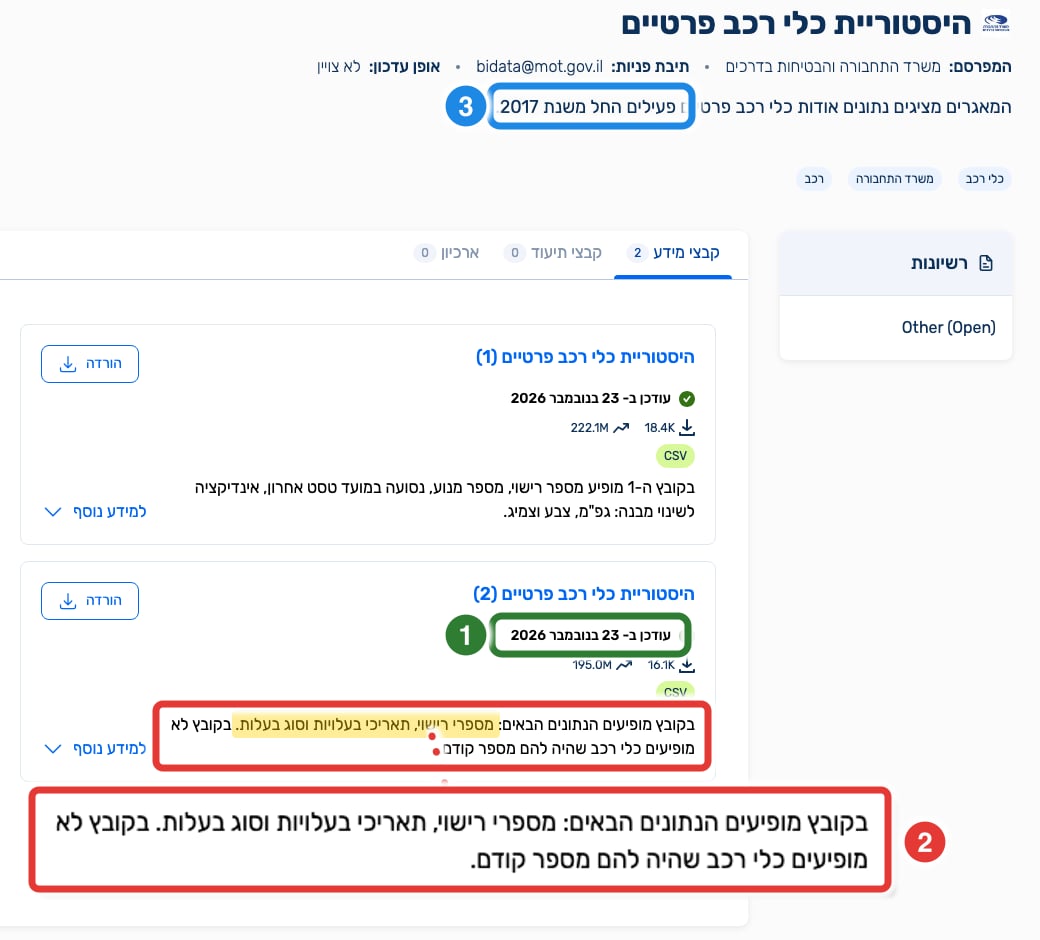
The dataset itself is very modest. In the green circle (1): the second file was updated on November 23, 2026, so the data is fresh. In the red frame (2), zoomed in: what it actually contains. A plate number, the date of each ownership registration (month and year only), and the owner type: private, company, leasing or dealer. No names, no prices. And the last sentence there matters just as much: vehicles that changed plate numbers don't appear at all. Number 3 is a reminder that this covers active vehicles only.
I cross-referenced that file with the main registration database, which lists 16,958 XPeng cars as of the same day. 2,585 of them, about 15%, have had more than one owner. But the figure that stopped me is when it happened: for 1,413 cars, the first change came within two months of registration. For 1,009 it came after six months or more, and that already looks like a normal used market.
The database doesn't say who the first owner was, only what type of owner. So I can't claim that every one of those 1,413 cars is an importer "0 km" car. What I can say is that the pattern repeats. More than half, 751 cars, went from a "private" owner straight to a dealer. Another 509 went from a company or leasing firm to a private owner. All within two months.
What the importer calls "0 km"
The simplest explanation comes from the importer itself. XPeng Israel's website has a page called "0 km vehicle terms", and it is worth reading to the end.
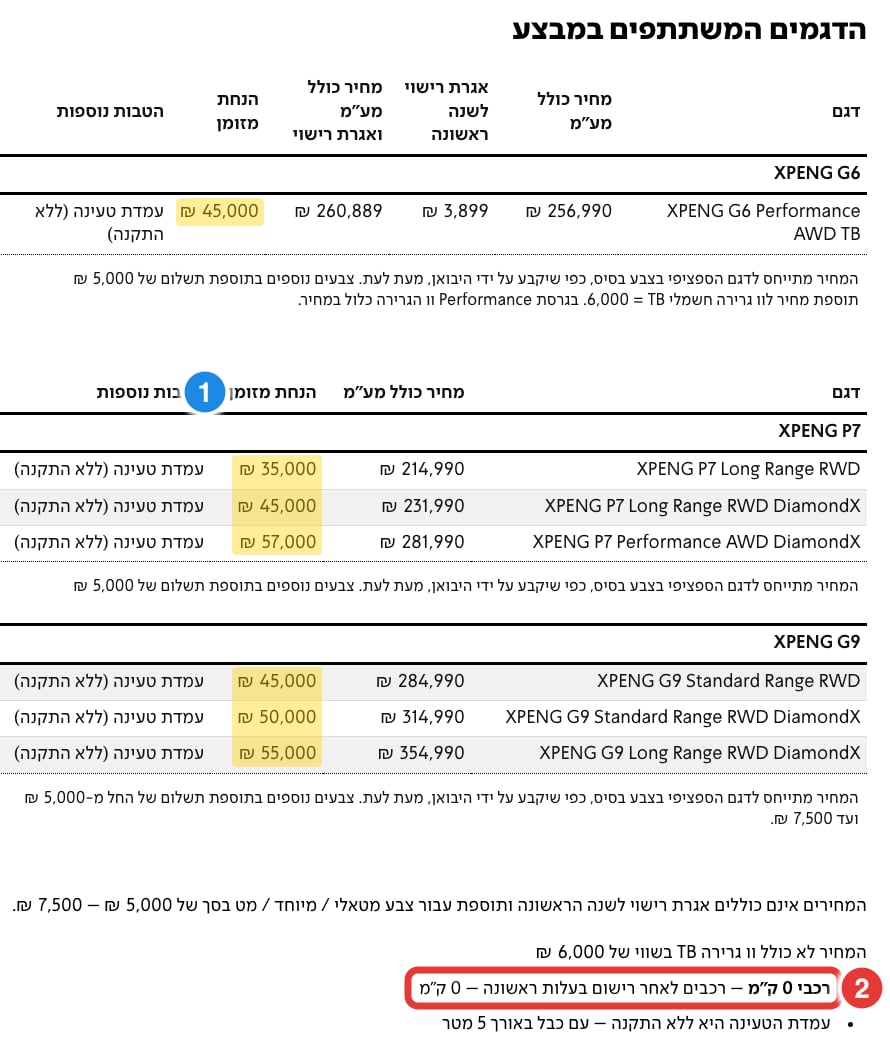
Number 1 marks the discount column, in yellow. These are not small. ₪45,000 off the G6 Performance AWD, and up to ₪57,000 off the P7. The red frame (2) is a single line at the bottom, after all the prices, defining 0 km vehicles as "vehicles after first ownership registration". In plain terms, the car is already registered to someone before you sign, and you will be the second owner on the logbook.
It isn't hidden. It isn't in the headline either. Two more conditions from the same terms, outside the screenshot: the discount applies only to cash deals, "not through a trade-in and/or financing transaction", and stock is "a minimum of 10 vehicles of each model". One more thing worth noticing: every G6 and G9 version in the table is the previous version. They still appear in the importer's price list, but below the new Core versions, which are flagged there as NEW.
Let's put it in shekels. The G6 Performance AWD on the deal costs ₪211,990 after the discount, before licensing fees. The new Core Performance AWD lists at ₪239,990 (as of November 4, 2026). And for perspective: the rear-wheel-drive Model Y is listed at ₪243,160, according to auto.co.il, as we reported in our G6 vs Model Y comparison. That's ₪31,000 less for a car with two motors. On paper? A strong deal.
To my mind it really is good, but only for a certain kind of buyer. If you plan to keep the car six or seven years, one extra owner on the logbook will barely matter. If you change cars every three years, you will meet it again on the day you sell, because in the Israeli market people ask "which hand?" first and "how many kilometres?" second. No public database publishes the exact price of that extra hand, and I won't guess it either.
The P7: four in ten have already changed hands
Break the data down by model and one stands out. Of the 1,785 P7s on the road, 727 have already changed owners at least once. That's 41%. For the G6, XPeng's most common model in Israel, it's just 11%.
There's a reasonable explanation. According to the registration database, the last P7 hit the road in September 2025, and it has been waiting for a replacement ever since. The P7+ is already here, and the new-generation P7 doesn't appear in the Israeli price list. And yet the terms offer it with a discount of up to ₪57,000. A car that hasn't been registered for more than a year, sold today as 0 km, is by definition a car sitting on a 2025 registration. Anyone buying one now should know that before comparing its price with the P7+ at ₪199,990.
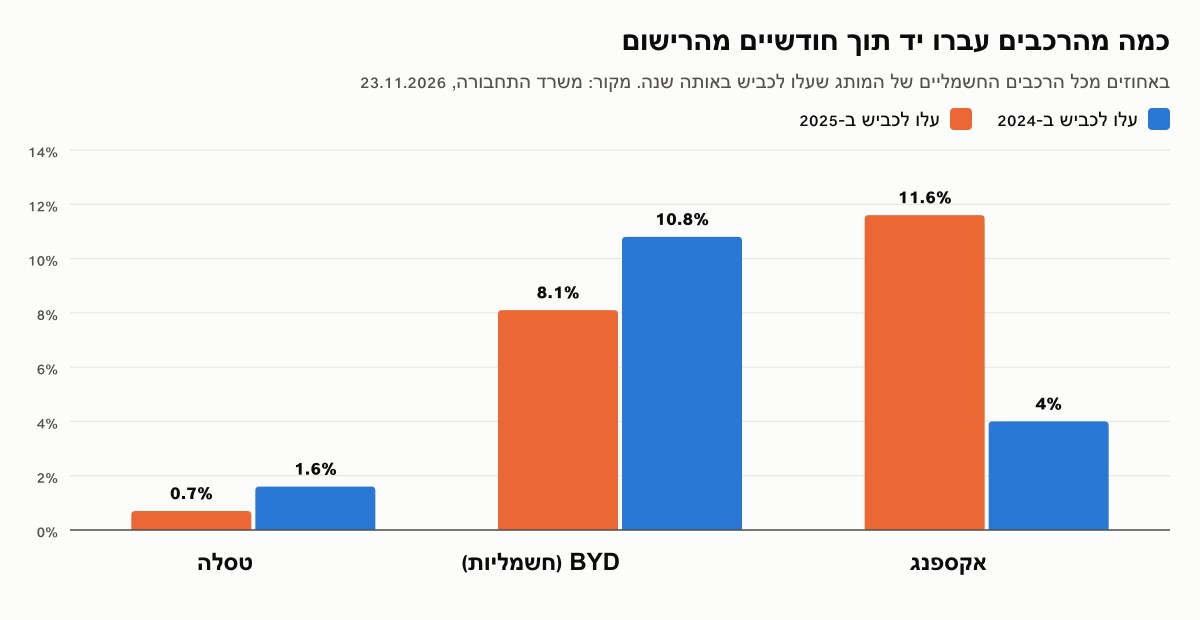
This chart is more interesting than the absolute number. Among cars first registered in 2024, XPeng was actually relatively clean: 4% changed hands within two months, against 10.8% for BYD's EVs. In 2025 the picture flipped, and XPeng rose to 11.6%. At Tesla, the same year, it happened to 0.7% of cars. That gap doesn't say one car is better than the other. It says something about the sales model: Tesla doesn't hold registered stock it needs to clear, so it doesn't run 0 km deals either.
And the real used market? It's actually waking up
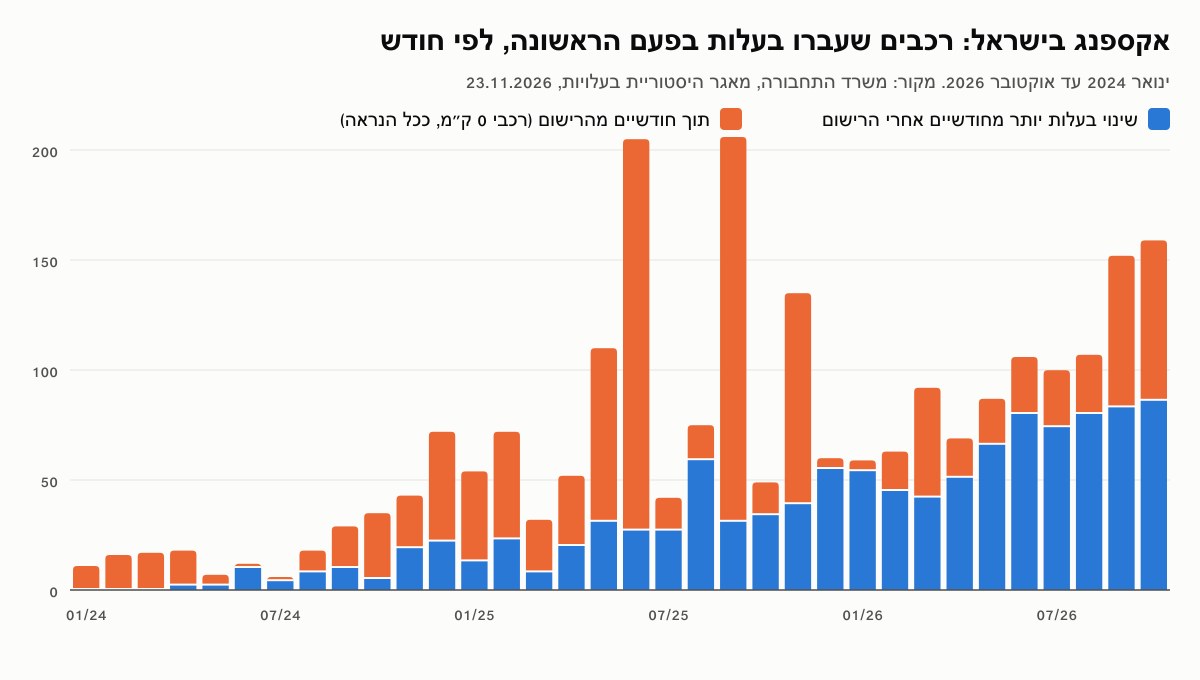
The orange bars are the quick changes, within two months of registration. They come in waves. 177 in June 2025 and 174 in September. These are probably months when a whole batch of stock was registered at once. I found no official statement on this, so I'm leaving it as a hypothesis.
The blue is the story I've been waiting a year for. These are cars that changed owners more than two months after registration, so mostly genuine used sales. Across all of 2025 there were 367 of them. In the first ten months of 2026, already 661. From June onwards it's running at 74 to 86 a month. One more small detail from the same database: 74 G6s were originally registered as driving school cars. If you're looking for a used G6, check that too. Michal gathered the other checks, and how to work out a fair price, in our used XPeng G6 buying guide.
An active used market is exactly what XPeng was missing to be seen as a safe choice. Tesla has had one for a long time, with tens of thousands of cars on the road and buyers who know roughly what a 2023 Model 3 is worth. XPeng doesn't yet have an established used price guide, and deals on registered stock won't help build one. In the meantime, if you're considering a used XPeng, ask the seller for the plate number and check the previous owner types yourself on the Ministry of Transport website. If "second hand" started at a dealer a month after registration, it was probably a 0 km car, and that's a very different story from a car a family drove for two years.
One last note. I haven't seen the cars themselves. Every number here was calculated from Ministry of Transport files as downloaded on November 23, 2026, and the comparison with Tesla and BYD covers EVs only. For background on sales, see our piece on XPeng as Israel's best-selling EV brand, and for the up-to-date car count, the XPeng on the road page.
Sources
- Private vehicle ownership history dataset, Ministry of Transport (two files, updated 23.11.2026): data.gov.il/he/datasets/ministry_of_transport/shinui_mivne
- Private and commercial vehicle registration dataset, Ministry of Transport (updated 23.11.2026): data.gov.il/he/datasets/ministry_of_transport/private-and-commercial-vehicles
- 0 km vehicle terms, XPeng Israel (checked 23.11.2026): heyxpeng.co.il/sale-terms
- XPeng price list (checked 23.11.2026): heyxpeng.co.il/pricing
- Tesla Model Y price from auto.co.il, as quoted in our comparison of 6.11.2026