WorldGPT: XPeng wants one brain for a car, a boat and a robot. We read the table down to the last line
 Ron Alon · Published · 6 min read
A car, a boat, a drone, two kinds of robotic arm and a humanoid robot. Six very different machines and, according to XPeng, one model that learns from all of them. That is how the company presented WorldGPT on November 24, 2026, one day before AI Day in Guangzhou. In the shadow of the big event, the release got almost no attention.
In the article
In Israel, anyone who follows the field thinks first of Mobileye in Jerusalem, which develops chips and software for driver assistance and sells them to many carmakers. XPeng takes the opposite route and builds everything in-house, from the Turing chip up to the model. WorldGPT is the top floor of that building, so it is worth understanding what it is, even if it won't reach your parking spot tomorrow.
A teacher in the cloud, a student in every machine
The idea, according to the release, is fairly simple. Today every machine gets its own AI system: the car learns to drive, the arm learns to pick up a cup. But both need to understand the same basic thing: where an object is and what will happen in the next second. WorldGPT is a large "teacher model" that runs in the cloud and learns from the cameras of all six machines. Its knowledge is then distilled into small "student" models that run on the machine itself. Given one second of video and a short instruction, it is supposed to generate video of what happens next and plan an action. Then it explains in words why it chose it.
Two years ago XPeng was a car company talking about autonomous driving. Today it calls itself a "physical AI" company, and a single model for every machine is exactly what is meant to justify the label. Tesla has also been saying for a while that its Optimus robot relies on the same AI that drives its cars. XPeng simply gave the idea a product name.
Twelve first places, and three small notes
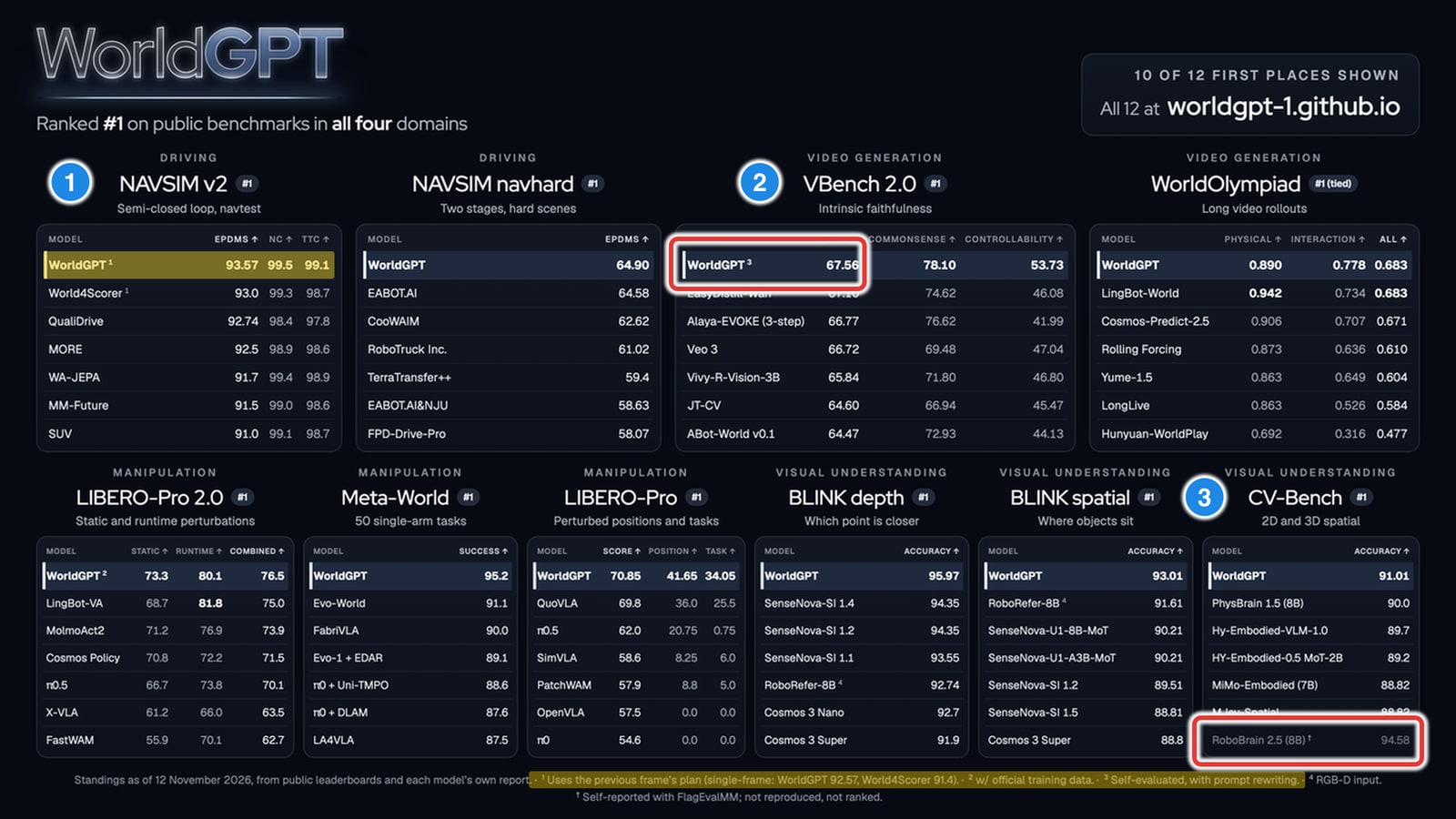
The release's headline is twelve first places on public benchmarks, as of November 12, across four areas ranging from driving to video generation. The table itself shows ten of them. And the small line at the bottom, which I highlighted in yellow, holds caveats worth reading.
Number 1 is NAVSIM v2, the test closest to actual driving. WorldGPT scores 93.57, against 93.0 for the runner-up. Footnote 1 explains that this score also uses the plan from the previous frame. Without that help, on a single frame, it drops to 92.57, against 91.4 for a rival measured the same way. It is still first, so nothing here is misleading. But the gap is smaller than the table suggests at first glance.
Number 2, in the red box: in video generation WorldGPT is first on VBench 2.0 with 67.56. Next to its name sits footnote 3, and at the bottom it says the score was "self-evaluated, with prompt rewriting". In other words, XPeng measured itself.
And number 3, the second red box. On CV-Bench, a spatial-understanding test, there is a grey line at the bottom of the table: RoboBrain 2.5 with 94.58, more than WorldGPT's 91.01. It isn't ranked because, according to the footnote, its score was self-reported and not reproduced. A fair rule, in my view. Too bad the same rule doesn't apply to WorldGPT's own score in the video test.
That doesn't make the results worthless. In robotics, a 95.2% average success rate across 50 single-arm tasks is an impressive number. But there is a clear gap with GroundingPI from earlier this month: that one came with an arXiv paper and open-source code on GitHub. WorldGPT currently has a project site where the technical report is marked "soon", with no researchers' names and not a word about code or weights. Until the paper is out, nobody outside XPeng can check the numbers.
And in a parking lot in Herzliya?
Nothing, for now. The "student" models need hardware to run on, and NGP, XPeng's urban driving system, is coming to Europe only on versions with Turing chips, as we wrote when test rides opened in Paris. The Israeli price list has no such version today. The G6 or G9 sold here won't get WorldGPT in an update, and the release doesn't promise anything of the kind. It names no date and no model.
What you can take from it is a direction. XPeng is building a whole tower in China. At the base, its own chip; above it, a simulator (X-World 1.6 was updated the day before) and a driving model; and at the top, WorldGPT. Anyone buying an XPeng in Israel today is buying an electric car with a lot of equipment for the money, and with XPILOT ASSIST doing what driver-assistance systems do. The rest they get, if at all, as a promise.
And on the stock market? Anyone holding XPeng stock in New York (XPEV) saw a 3.9% rise on November 24, to a close of $9.02 (about ₪30.2 at the Bank of Israel representative rate that day, ₪3.345 to the dollar). The next day, AI Day, the stock closed almost unchanged at $8.99. It is hard to pin a move like that on a single release, in a week when the whole company was on stage. And remember that on November 20 the stock lost almost 14% in one day, before WorldGPT was even revealed.
We'll wait for the technical report. If it comes out with the full numbers, we'll come back to this.
Sources
- XPeng release, "XPENG Unveils WorldGPT, a Single AI Model That Learns Across Cars, Robots and Drones", 24.11.2026: xpeng.com/news/01a20bcf44b3a1e838d68a02a2110153
- WorldGPT project site, including the results table and footnotes (checked 26.11.2026): worldgpt-1.github.io
- XPEV closing prices on the NYSE, 20 to 25.11.2026, Yahoo Finance (checked 26.11.2026): finance.yahoo.com/quote/XPEV/history
- USD/ILS representative rate, Bank of Israel, 24.11.2026: boi.org.il
- XPeng Israel price list (checked 26.11.2026): heyxpeng.co.il/pricing