GroundingPI: the model XPeng opened to everyone, and the line worth reading at the end of the announcement
 Ron Alon · Published · Updated · 6 min read
"The handle of the cup on the right." That is the example XPeng picked to explain GroundingPI, and it does the job better than any chart. A robot given that instruction first has to find the right cup among several on the table, then the exact spot where you grab it. A general-purpose language model can describe a picture very well. Saying precisely where the handle is, in coordinates, is another matter.

In the article
On November 4, 2026, XPeng published an announcement about GroundingPI, an open-source vision model developed by researchers affiliated with the company together with Peking University, the University of Hong Kong and other institutions. Like Tesla with its Optimus robot, XPeng has been presenting itself for a while as a "Physical AI" company rather than just a carmaker, and this model is one more brick in that story. The real question, for anyone reading from Israel, is how much of it will ever reach the road. The answer, it turns out, is written in the announcement itself.
The win over OpenAI, at actual size
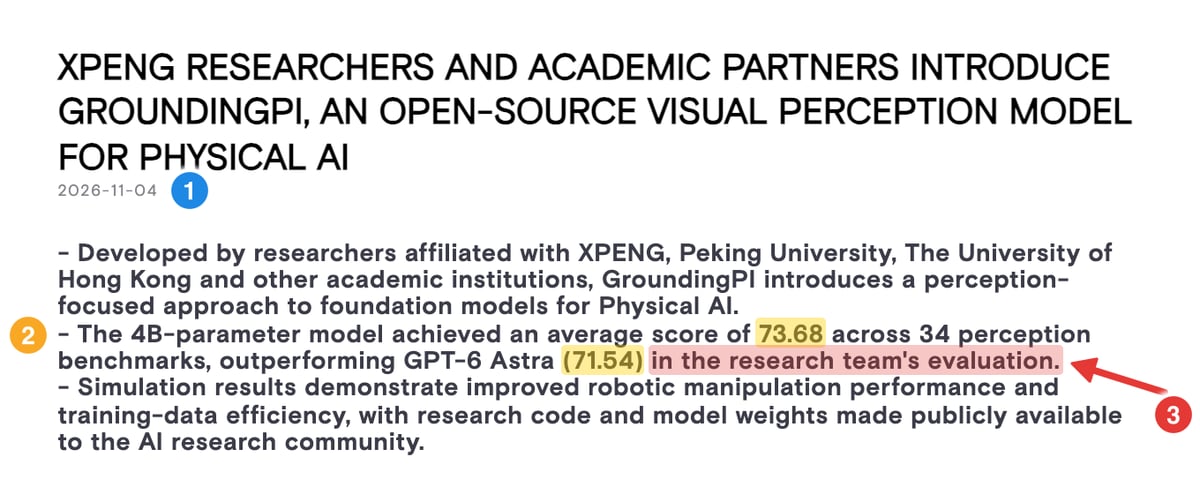
The headline that went around was "XPeng beats OpenAI". The yellow marks (2) show what it rests on: an average score of 73.68 across 34 public perception benchmarks, against 71.54 for GPT-6 Astra. According to the announcement, 44 models were compared, and the benchmarks cover 11 kinds of capability, from spotting small objects in a crowded image to finding a button on an app screen.
Now the red mark (3). The comparison was made "in the research team's evaluation", in other words by the people who built the model. That is normal practice in academic papers, and I have no reason to doubt the numbers. But a gap of just over two points, on benchmarks the team chose and weighted equally, is not the same thing as beating OpenAI. XPeng itself writes further down that the comparison "does not represent a broader assessment of general AI intelligence". Fair play. A pity most headlines did not copy that line too.
The date in blue (1) also tells you something. The paper went up on arXiv on September 30, 2026, and was revised to a third version on November 19. The press release came a month after the researchers had published the work, so this is research the academic community could already check, not a surprise pulled out ahead of an event.
What the announcement does not stress: according to the GitHub page, GroundingPI was not built from scratch. It pairs a vision encoder from Moonshot AI's Kimi K3 with Alibaba's Qwen3-4B language model. That is how most labs work today, nothing embarrassing about it. It is just a reminder that XPeng's edge here lies in the training and the data, not the foundation.
Robots that learn faster. On a computer, for now.
What interests me more than the score is what happens when the model gets a "body". A robot learns a new task mostly from demonstrations: a human showing it, again and again, how to lift, move or open something. That is slow and expensive. In a simulation called RoboCasa-GR1, a system using GroundingPI as its "eyes" did better when trained on half of the demonstrations than the comparison systems did when trained on three quarters. In another simulation, RoboTwin 2.0, it coped better with settings it had not seen in training, such as a different background or different objects.
There is one line about cars. On nuScenes, a dataset of recorded drives, the model predicted the car's path with an average error of 0.296 metres, roughly thirty centimetres from the path the driver actually took. That is an "open-loop" measurement, on a recording, with no car actually driving. On paper, it shows the same vision model can be used for driving. In practice, it is a very long way from a system that drives on a real road.
The line at the end of the announcement
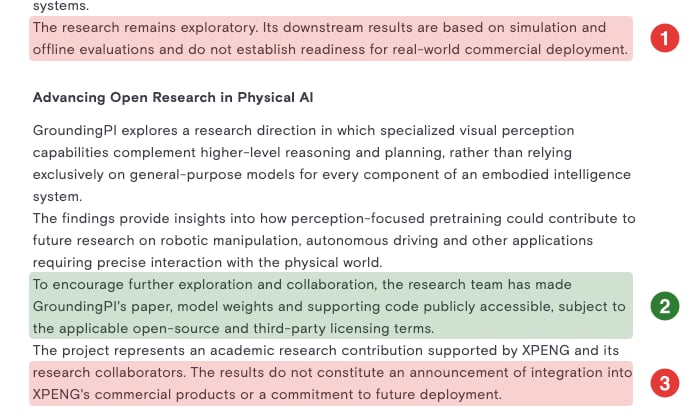
Anyone who scrolled to the end found two sentences you will not see in the headlines. The first, in red (1): the research "remains exploratory", its results are based on simulation, and they "do not establish readiness for real-world commercial deployment". The second, in red (3), is even clearer: the results "do not constitute an announcement of integration into XPENG's commercial products or a commitment to future deployment". Not my reading. A quote.
The green highlight (2) is the genuinely good part. The paper, the code and the model weights were released to everyone, not just described nicely in a press release. The GitHub code is under the Apache 2.0 licence, with one caveat spelled out there: the parts derived from Kimi K3 stay under Moonshot AI's licence. As of November 23, the project had 442 stars on GitHub. Real academic interest, not a stampede.
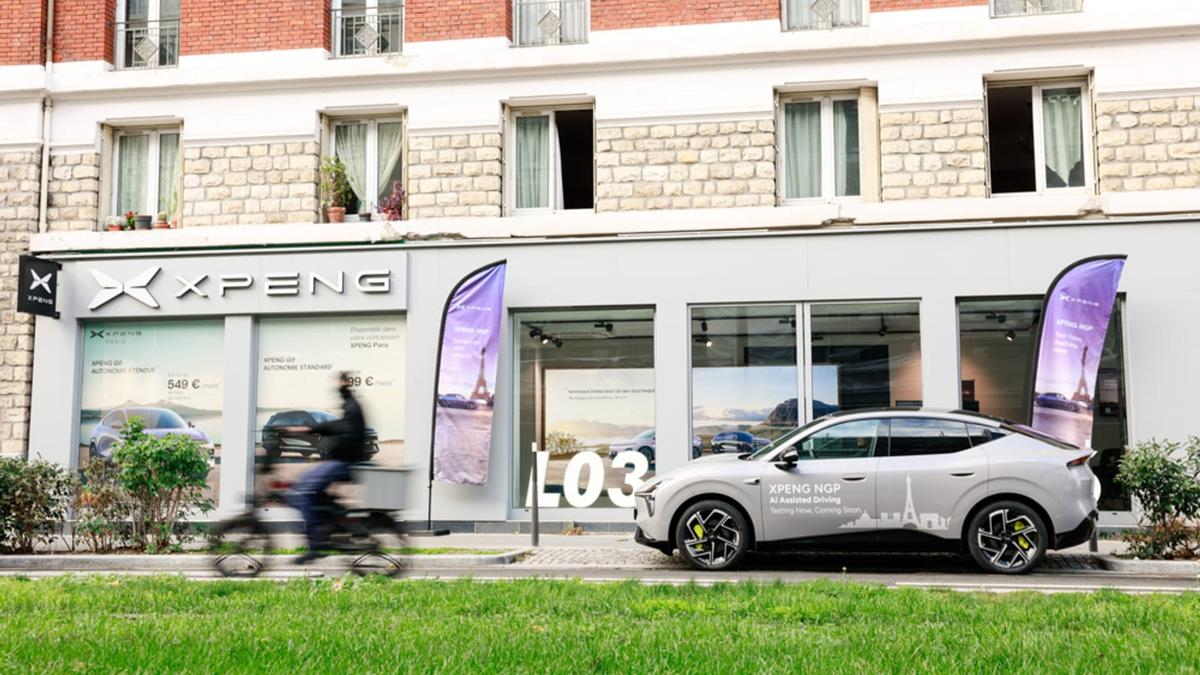
So what does it mean for someone driving a G6 in Herzliya? Directly, nothing. GroundingPI will not arrive in an over-the-air update, and XPeng says so itself. Even NGP, the driver-assistance system already running in China and now being shown in test rides in Paris, has not been announced for Israel. For perspective, Tesla's Israeli site lists FSD as a ₪37,500 option, with a note that it is not yet available here. In Israel, advanced driver assistance depends on the importer and the Ministry of Transport, not on a paper on arXiv.
Indirectly, the research does say something about the company behind the car. XPeng is putting money and people into AI that serves its cars, the IRON robot and the YOYO robotaxi in Guangzhou all at once. Buying one of its cars means buying into that bet as well. If you want to know how much of it actually reaches the cars, the next chance is AI Day on November 25. We will wait and see.
Sources
- XPeng's announcement on GroundingPI, 4.11.2026 (read 23.11.2026): xpeng.com/news/01a1a60de92ba181a8f48a02aa970133
- The arXiv paper, "GroundingPI: A Grounding Foundation Model towards Physical Intelligence with Visual Primitives", version 3 of 19.11.2026: arxiv.org/abs/2609.39601
- The GitHub code page (model architecture, licence, star count as of 23.11.2026): github.com/groundingpi/GroundingPI
- The Hugging Face model page (licence and vision encoder, checked 23.11.2026): huggingface.co/GroundingPI/GroundingPI
- FSD price on Tesla's Israeli site, read 23.11.2026: tesla.com/he_il